" height="70px" id="RzWLSDEhO" width="166.45666943593332px"/></svg>)

In international trade, efficiency and clarity in transactions are crucial factors for the success of any operation. This is where Incoterms (International Commercial Terms) come into play, a set of international rules that standardize the responsibilities between buyers and sellers during the transportation of goods. They help answer essential questions: who bears the costs? Who assumes the risks? Who should handle the logistics at each stage of the operation?
These definitions not only simplify negotiations but also minimize conflicts, ensuring that all parties involved are aligned. If you are involved in international trade, understanding Incoterms is a must for planning import and export operations with safety and efficiency.
What are Incoterms?
In the realm of international trade, Incoterms (International Commercial Terms) are standardized rules created by the International Chamber of Commerce (ICC) to define responsibilities between buyers and sellers in global commercial transactions. They eliminate ambiguities related to the transportation of goods, establishing who pays costs, who is responsible for insurance, and who assumes the risks at each stage of the logistics process.
Launched in 1936 and periodically updated, the latest version is Incoterms 2020, which reflects changes in international trade practices.
Why are Incoterms important?
Incoterms are essential for:
Reducing risks: they prevent misunderstandings about who should pay or assume responsibilities.
Facilitating negotiations: they provide a common language between parties from different countries.
Ensuring legal compliance: they help meet international regulations.
Main categories of Incoterms
Incoterms are divided into two main groups:
1. For any type of transport
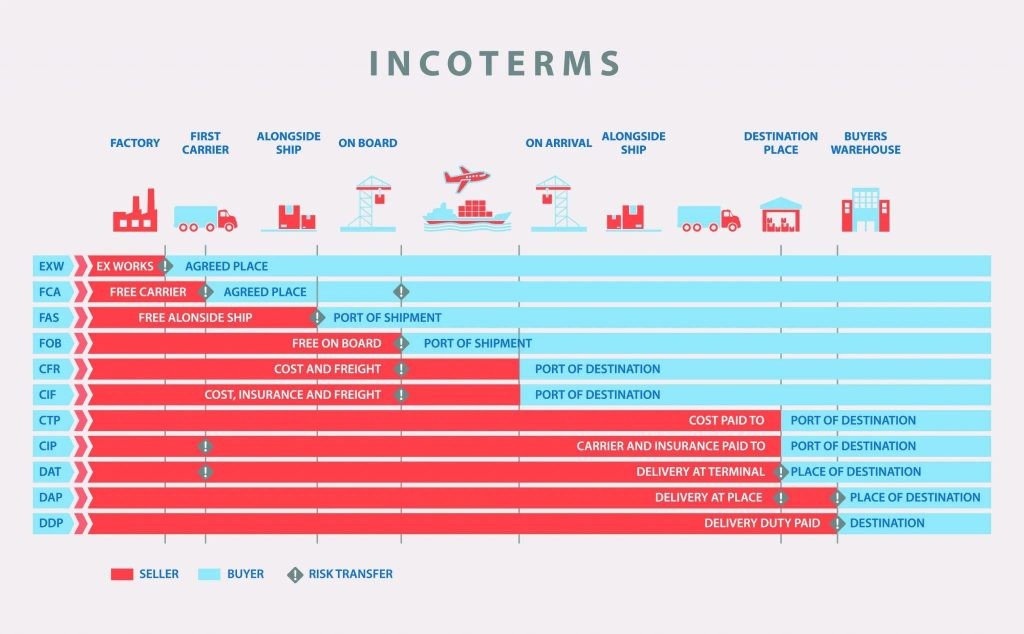
EXW (Ex Works): the seller makes the goods available at the place of origin; the buyer assumes all costs and risks.
DAP (Delivered at Place): the seller delivers the goods to the location designated by the buyer, without unloading.
DDP (Delivered Duty Paid): the seller assumes all costs and risks, including taxes and customs clearance.
2. Specific for maritime transport
FOB (Free On Board): the seller delivers the goods at the designated shipping port, assuming costs up to the ship.
CIF (Cost, Insurance, and Freight): the seller covers cost, insurance, and freight to the destination port, but risks transfer to the buyer upon shipment.
How to choose the right Incoterm?
The choice depends on factors such as:
Desired control and costs: companies with greater logistics expertise may prefer Incoterms that delegate fewer responsibilities to the seller, such as EXW.
Type of goods and transport: bulky or fragile products may require Incoterms that include insurance, such as CIF.
Relationship between parties: long-standing partnerships may benefit from more collaborative Incoterms, such as DDP.
How do Incoterms impact daily life?
For Brazilian companies that import or export, understanding Incoterms is essential for planning costs, negotiating contracts, and avoiding financial surprises. In addition, they assist in risk management and in clearly defining responsibilities between shippers and buyers.
At Fast Shipping, we help our clients choose the ideal Incoterm for each operation, ensuring efficiency and security at all logistical stages. Our know-how in freight forwarding simplifies complex processes and brings more peace of mind to your business.
Mastering Incoterms is crucial for anyone involved in foreign trade. They are more than just rules: they are strategic tools that help optimize operations and strengthen international partnerships.
If you want to know how to apply Incoterms in your operation, count on the experience of Fast Shipping. We are here to simplify your international logistics!