" height="70px" id="RzWLSDEhO" width="166.45666943593332px"/></svg>)

In the last six months, container shipping companies have been rerouting cargo around Africa to avoid attacks by Houthi rebels in the Red Sea, circumventing the Suez Canal. What once seemed unlikely has now become the norm, impacting the industry's capacity and causing exit rates from Asia to surge.
Despite the possibility of a ceasefire between Gaza and Israel, the Houthi rebels have little motivation to cease their attacks. The United States shows no intention of intervening militarily, and a political resolution seems unlikely.
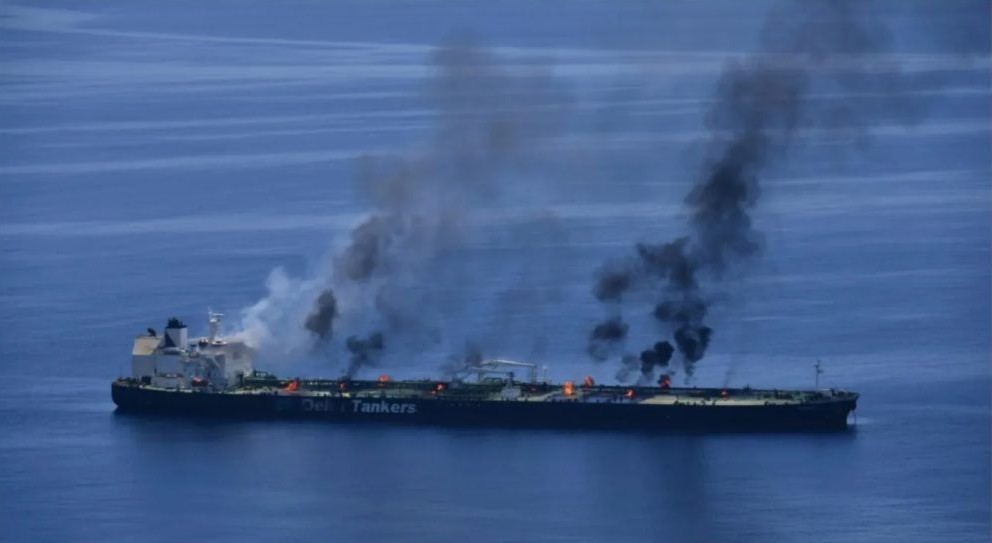
Attack occurred in August 2024.
Jack Kennedy, associate director of country risk for the Middle East and North Africa at S&P Global Market Intelligence, explained that the ongoing blockade of Yemen's oil export terminals by Houthi forces prevents any sustainable agreement. “Current operations led by the U.S. have not completely prevented Houthi attacks on maritime transport, and the group continues to demonstrate its capability to deploy various weapon systems to damage vessels,” Kennedy noted, adding that progress toward a broader ceasefire appears to be stalled.
Aligned with the Palestinian cause, the Houthi rebels have gained significant influence and increased recruitment since they began attacking container ships last November. Geopolitical analysts argue that it is unlikely they will stop, even if the conflict between Israel and Hamas ends.
The announcement of a possible ceasefire between Israel and Hamas on June 11 led to a drop in the stock prices of shipping companies like Maersk and Hapag-Lloyd. Johan Sigsgaard, speaking to the Danish newspaper Børsen, emphasized that a ceasefire between Israel and Hamas does not guarantee the end of Houthi attacks. Meanwhile, the CEO of Hapag-Lloyd, Rolf Habben Jansen, remains optimistic about a resolution in the Red Sea in the next 18 months, stating that he believes the global powers will not allow the critical trade route of the Suez Canal to remain compromised.
Recently, the bulk carrier Tudor sank after being attacked by a Houthi drone boat, marking the second ship lost due to the rebels' actions, after another bulk carrier was attacked and sunk in March. These diversions are significantly affecting global shipping capacity. Analyst Heather Hwang estimates that 5% to 9% of global effective capacity is currently consumed by these redirected shipments. She predicts that relief may arrive in September if congestion in Asian ports decreases or if ship deliveries are accelerated.
U.S. East Coast and European container routes now require 29 ships with capacities of 12,500 TEUs or more to compensate for the longer trips around Africa. With 31 of these ships expected to be delivered by the end of September, it seems that these diversions will continue in the foreseeable future.