" height="70px" id="RzWLSDEhO" width="166.45666943593332px"/></svg>)

Importing cargo for the first time may seem like a complex process, but with planning and knowledge of the necessary documents, types of containers, and advisory options, it is possible to carry out an efficient importation without setbacks. In this article, we will detail each step so that you can start your import journey with confidence.
1. Necessary Documents for Importation
To ensure that your cargo arrives at its destination correctly and without customs issues, you will need a series of mandatory documents:
a) Commercial Invoice
This document is issued by the supplier and details the purchased products, including description, quantity, unit price, and total, as well as the exporter and importer information.
b) Packing List
The packing list is a document that specifies how the goods are packaged, including weight, dimensions, and packaging method.
c) Bill of Lading or Air Waybill
Depending on the mode of transportation used (maritime, air, or land), this document will be issued by the carrier and serves as a receipt for the goods and a transportation contract.
d) Import Declaration (DI) or Simplified Import Declaration (DSI)
Document registered in the system of the Brazilian Federal Revenue (Siscomex) for the clearance of goods.
e) Import License (when applicable)
For some products, it is necessary to obtain prior licenses from regulatory bodies such as Anvisa, MAPA, and Inmetro.
f) Certificates of Origin and Quality
These certificates are required for products subject to trade agreements or specific quality and safety requirements.
g) Radar (Record and Tracking of Customs Interveners)
The Radar is the necessary registration for companies or individuals to operate in foreign trade. It is mandatory to carry out imports and must be obtained from the Brazilian Federal Revenue.
2. Common Types of Containers
The type of container chosen directly impacts the cost and safety of the cargo. See the most common:
a) Dry Container (Standard)
Used for most dry cargo, available in standard sizes such as 20, 40, and 45 feet.
b) Reefer Container
Equipped with a refrigeration system for transporting perishable products, such as food and medicines.
FCL (Full Container Load) vs. LCL (Less than Container Load)
The choice between FCL and LCL depends on the volume of the cargo and the logistical needs of the importer.
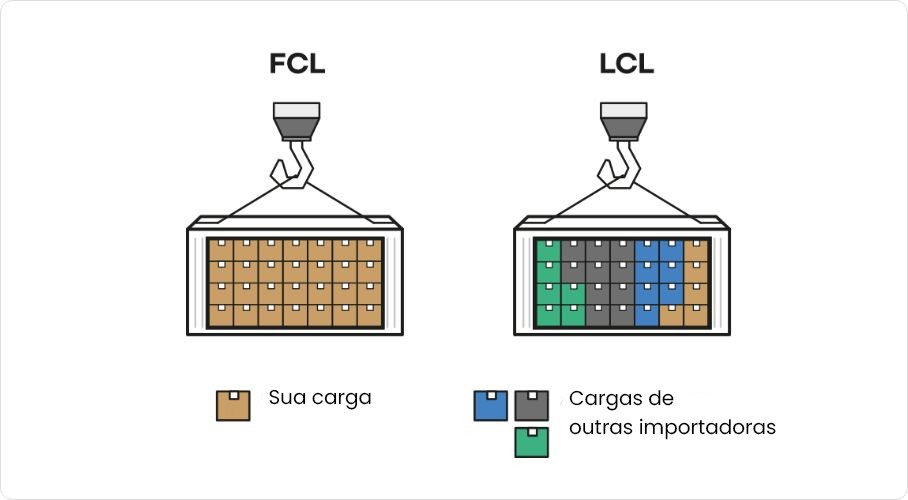
FCL (Full Container Load) – Full Container
In this model, the importer rents an entire container, regardless of whether it occupies the full capacity.
Advantages:
Greater security, as the cargo is not shared with other importers.
Less risk of damage or contamination.
Generally shorter transit times, as there is no need to consolidate or deconsolidate the cargo.
Disadvantages:
Higher fixed cost, since the importer pays for the entire container regardless of the space used.
Need for a larger volume of goods to justify the investment.
LCL (Less than Container Load) – Less than a Container Load
In this model, the importer shares the container space with cargo from other importers.
Advantages:
Cost reduction, as the importer only pays for the space occupied.
Ideal for small volumes of goods.
Flexibility to test suppliers and import small quantities before expanding.
Disadvantages:
Longer transit time, as it is necessary to consolidate and deconsolidate shipments at logistics centers.
Increased risk of damage or contamination, since the cargo shares space with other products.
Extra handling costs upon arrival at the destination.
3. When to Seek Consulting or Trading?
Depending on the complexity of your import, it may be advantageous to rely on the support of a specialized company. See when this is recommended:
a) When bureaucracy is complex
If the goods require special licenses or undergo rigorous regulatory processes, a consulting service can prevent errors and delays.
b) When there is no internal structure
If the company does not have a dedicated team for foreign trade operations, outsourcing the process may be more efficient.
c) When seeking cost optimization
Traders and consultants may have access to better commercial conditions, helping to reduce logistical and tax costs.
d) When there is urgency in importation
If you need the cargo to arrive quickly and without setbacks, experienced professionals can expedite the process and avoid common mistakes.
Importing for the first time requires planning and knowledge of the necessary documentation, the ideal type of container, and the possible need for specialized consulting.
With your company in accordance with all the necessary documents, the easy part has come! Just call Fast Shipping and start your cargo quotation.